

Classically Curious: The Story Behind Your Favorite Classical TikTok Soundbite
How hypnosis saved Rachmaninoff's career, led to the composition of his famed Second Piano Concerto, and why you should listen to it in its entirety.

“A cynic is a man who knows the price of everything, and the value of nothing.” — Oscar Wilde, Lady Windemere’s Fan
Nine chords, each rising in intensity. This is how the first movement (Moderato) of Rachmaninoff’s famed second Piano Concerto, Op. 18, opens.
The scene is set and vulnerable. A piano against the force of a full orchestra, establishing the springboard on which the violins can effortlessly bounce into the first theme as the piano fades into the supporting role, embellishing what the low vibrations of the strings bring forth. But it doesn’t slide into obscurity. The heaviness of the bassline anchors the vastness of the orchestra, reminding the listener that this isn’t a piece that simply sweeps you off your feet (although that second movement is pretty swoon-worthy).
Every pianist who has ever worked through the score knows intimately its physical, psychological, spiritual, emotional, and musical demands. (Especially if you have small hands like yours truly.)
This concerto was fought for. It was a labor of love and persistence—a piece born out of depression and despair, with a little nudge from hypnosis.

This piano concerto launched Rachmaninoff into the stratosphere of commercial success. It’s why, no matter how unfamiliar you are with the classical repertoire, I know you’ve heard vignettes of the Second Piano Concerto. Specifically, the romantic and dramatic second movement (Adagio sostenuto).
It was featured in the final scene of the 1945 film, Brief Encounter, served as melodic inspiration for Eric Carmen’s All By Myself, and the movement’s climax is now a trending sound on TikTok.
 Tiktok failed to load.
Enable 3rd party cookies or use another browser
The second movement is undeniably a masterpiece. Opening softly with muted strings, the undulation of arpeggios from the piano, and the gentle call of a flute, deepened with the layering of a clarinet. It eventually hands the melodic baton over to the soloist as the piano continues its nocturne-like theme. The exposition develops with a back and forth between the piano and the flute, mimicking an intimate yet fragile dialogue, neither daring to push beyond a hush. This tender balance makes the climax (as heard in the TikTok clip above) all the more precious.
But I’m getting ahead of myself.
If I could convince you to listen to one piece of music all the way through (as it was intended), it would be this concerto. Not because of its timely rise in popularity on social media. But because this is one of the greatest pieces of music ever composed, and reducing it to a soundbite feels sacrilegious.

I thought it appropriate to publish this essay on this date, as it marks the 124th anniversary of the concerto’s historic premiere.
Under the baton of Alexander Siloti (Rachmaninoff’s cousin), the premiere took place at Moscow’s Nobility Hall with the Moscow Philharmonic and Rachmaninoff himself on the bench.
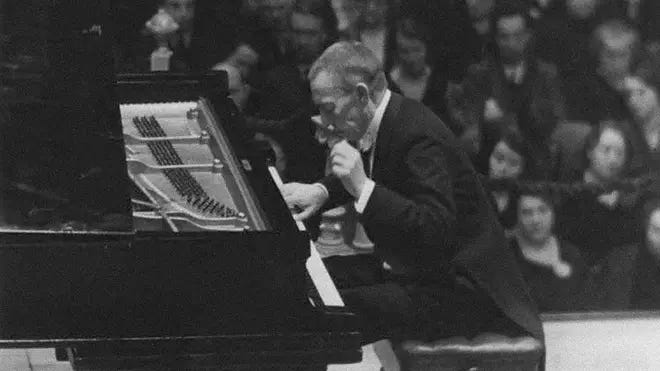
This was his comeback premiere after an intense struggle through creative constipation and alcohol abuse. Before the composition of the Second Piano Concerto, Rachmaninoff faced tremendous failure with the reception of his First Symphony.
Today, this symphony stands as a representation of Russian symphonic tradition, but its 1897 premiere was nothing short of disastrous.
César Cui, a composer and music critic (and member of The Five, a group of composers who aimed to create a distinct, Russian national style of classical music), compared the piece to “the ten plagues of Egypt.”
If there was a conservatory in hell, Rachmaninoff would get the first prize for his symphony, so devilish are the discords he places before us. — César Cui
Already prone to spells of depression (Stravinsky once described Rachmaninoff as an “everlasting six and a half foot scowl”), this critical failure shoved Rachmaninoff into an intense case of writer’s block. It was said that Rachmaninoff could not face a blank sheet of manuscript for two whole years after the premiere.
In his memoirs, the composer explained:
All my self-confidence broke down. A paralyzing apathy possessed me. I did nothing at all and found no pleasure in anything. Half my days were spent on a couch sighing over my ruined life. My only occupation consisted in giving a few piano lessons in order to keep myself alive.
To make matters worse, Rachmaninoff met one of his literary heroes, Leo Tolstoy. Music was an integral part of his artistry, with Tolstoy claiming it “penetrated the deepest recesses of my soul, it stirred my whole being, it released in me embryonic thoughts and emotions of which I myself was not cognizant.”
Shortly after the failed performance, Rachmaninoff played a few of his compositions for Tolstoy. This resulted in a confidence-shattering response:
Tell me, is such music needed by anybody? I must tell you how I dislike it all.
I guess it affirms the age-old saying, never meet your heroes. They might just destroy your will to create.

Unless you’re a musician tasked with learning the piece, or perhaps reading musical notation is a niche hobby of yours, you’ll likely miss the dedication inscribed at the top of the score.


Dr. Nikolai Dahl: Musician and hypnotherapist.
Hypnosis remains a controversial form of therapy even today. But back in the late 19th/early 20th century, it was heavily regulated and restricted. As with most prohibited practices, those with the means and desires, the movers and shakers of Moscow society found a way.
Dr. Dahl has seen the likes of many a great Russian artists, from opera singer Fyodor Chaliapin, to composer and pianist Alexander Scriabin. His work was even referenced by the playwright, Anton Chekhov
My relatives had informed Dr. Dahl that he must by all means cure me of my apathetic condition and bring about such results that I would again be able to compose. — Sergei Rachmaninoff
Having recently treated Rachmaninoff’s aunt, Dr. Dahl proceeded to douse the composer with repetitive affirmations for three months.
I heard the same hypnotic formula repeated day after day while I lay half asleep in an armchair in Dahl’s study. ‘You will begin to write your concerto… You will work with great facility… The concerto will be of an excellent quality.’ It was always the same without interruption. Although it may sound incredible, this cure really helped me. — Sergei Rachmaninoff

As a conservatory kid who grew up at the piano bench since the age of 3, my heart flutters whenever a piece of music starts gaining mainstream attention in this day and age. Maybe it was because I was often seen as a “nerd” in school by other kids who pursued “cooler” professions, like acting, dancing, or musical theater. Us classical Juilliard kids? Many of us couldn’t name you a Britney Spears album, but we could rattle off about Beethoven sonatas.
But if you’ve heard fleeting whispers of the second movement floating around your For You Page, I encourage you to sit through the entire piece, from the first movement to the last.
The genesis of this work emerged from the immense pain and public humiliation the young composer felt. It’s a testament to an artist's struggle, caught between daring risks and desired acceptance.
Reduced down to the romantic peak of the second movement featured on social media, that tummy fluttering feeling seems undeserved.
The first movement is stormy and tumultuous. Images of Sisyphus’ eternal punishment comes to mind from the jump, as a cacophony of different themes are ripped from piano to the rest of the orchestra, presenting a maelstrom of interconnectivity, a push and pull, a struggle for power and dominance until the towering end which ends decisively in its home key of C minor.
The second movement quickly modulates from the tonic to the more optimistic key of E major. Its climactic peak is what many would recognize today by way of film references, musical extrapolation, or 30-second soundbites. And it’s easy to understand why. It’s an epoch of sentimentality. Both the culmination and release of emotion.
Starting in E major, the third movement quickly moves us back to C minor. This is a beastly movement, testing not only the pianists’ musicality but their technical prowess as well. Look no further than the uncontrollable way the tempo lurches to a satisfying climax, with the finalé bringing us to the transformed C major.

I could wax poetic about this concerto. It is a piece that sonically embodies the excess of emotion felt in Russian art, from literature to music. In such a tumultuous time in Russian politics, one characterized by the rigid autocracy of the Tsarist regime, melancholy seemed to be a favorite subject matter. Rachmaninoff was not immune to the turmoils of deep emotional whiplash, all of which (thanks to hypnosis) was eventually channeled into his Second Piano Concerto.
I write that which is in my heart at the time I am composing…these moods become part of my music — Sergei Rachmaninoff
Needless to say, the reception of the concerto was greeted with fervent enthusiasm, a sentiment that has extended its reach into modern life as it reaches the shores of our algorithm.
P.S. Fun little anecdote. Rachmaninoff considered famed pianist Vladimir Horowitz to be the best interpreter of his work. My first piano teacher was Horowitz’s protégé, and he was responsible for launching my career as a pianist. In the classical music world, the history of your tutelage carries a lot of weight. It’s why so much of my focus is baked in Russian musical discipline.

The pianist you choose for your interpretation can shape your entire experience of the piece. While the Khatia Buniatishvili version is great (this is the one popularized on social media), I highly recommend Daniil Trifonov’s interpretation (I’ve linked all three movements throughout this article). Some other performances of the piece I enjoy include:
Evgeny Kissin’s (first link in the post)
There's a fantastic, obscure musical called Preludes about Rachmaninoff's time writing this piece! You can stream the soundtrack on Youtube and Spotify. It's by the composer of The Great Comet, so good, highly recommend :)
Beautiful. Thank you for sharing. It's so interesting to learn that All By Myself borrowed from this Piano Concerto. Please keep these posts up!